
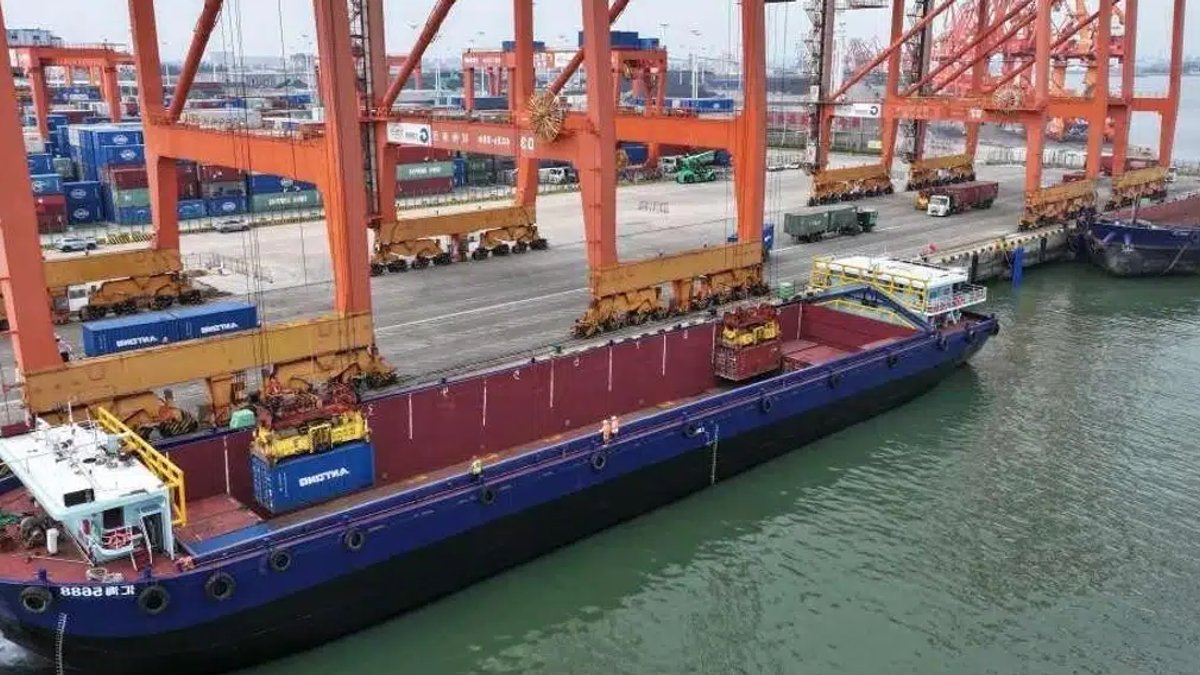
Two major canal projects in China and Cambodia are set to reshape trade trends in Southeast Asia. These developments could alter shipping routes and challenge Vietnam’s role in regional supply chains.
After four years of construction, China’s US$10.75 billion Pinglu Canal opened in September. The 134.2-kilometer waterway connects China’s Guangxi region to the Gulf of Tonkin. It provides manufacturers with a shorter route to Southeast Asian markets.
China’s Pinglu Canal Opens New Trade Routes
In its first month, the Pinglu Canal handled over one million tonnes of cargo. Its significance was highlighted on November 21 in Beijing during discussions between Singapore Prime Minister Lawrence Wong and Chinese Premier Li Qiang. They addressed its integration with the International Land-Sea Trade Corridor.
This network links western China to ASEAN markets. The canal could cut logistics costs by up to 30 percent by offering a shorter route through Guangdong province.
On September 24, the first container ship from China’s Nanning arrived at Can Tho Port in southern Vietnam. It carried 252 twenty-foot equivalent units of cargo. This service operates twice monthly, with a transit time of about seven days.
The Pinglu Canal Group projects annual cargo to surpass 100 million tonnes by 2035. Mickael Driol, CEO of Mekong Partners, noted the canal could enhance factory efficiency in Vietnam. Lower-cost access to Chinese suppliers might shorten replenishment cycles.
However, the canal’s benefits depend on more than just distance. Factors like cargo density, vessel frequency, and customs clearance also play a role. Some freight forwarders still favor established hubs such as Shanghai and Guangzhou.
The canal’s capacity limits its competitiveness with larger maritime routes. Its 5,000-tonne vessels are better suited for shorter trips. Cargo destined for distant markets often requires transfer to larger ships.
Cambodia’s Funan Techo Canal Aims to Bypass Vietnam
Cambodia is developing the 172.6-kilometer Funan Techo Canal. The project is 49 percent owned by Chinese investors. Construction of its second section began in April. A US$1 billion financing deal with China Exim Bank followed in September.
The canal aims to give Cambodia direct access to the Gulf of Thailand. It seeks to reduce dependence on Vietnamese ports. Cambodian Deputy Prime Minister Sun Chanthol estimated savings of US$155 to US$181 per container.
Read Also: Trump to host meme coin gala as coin value slumps
Phnom Penh plans to cut the share of its cargo passing through Vietnamese ports from one-third to 10 percent. It also aims to develop industrial parks and logistics hubs along the canal.
However, the impact on Vietnam may be limited. Huynh Trung Dung, a senior fellow at the ISEAS-Yusof Ishak Institute, noted that Cambodian transit cargo accounts for only 3 to 4 percent of Vietnam’s transhipment activity.
The canal’s viability remains uncertain. Its shallow depth and limited capacity could require additional cargo handling.
The project could also affect water flows and sediment transport in Vietnam’s Mekong Delta. This region already faces pressure from upstream dams and climate change. Environmental impacts are a major concern for Vietnam.
However, the rise of Chinese-financed infrastructure projects, many linked to the Belt and Road Initiative, raises geopolitical concerns.
Geopolitical Implications and Environmental Concerns
Huynh Trung Dung from the ISEAS-Yusof Ishak Institute notes that China’s investments in regional infrastructure, such as Cambodia’s Funan Techo Canal, may increase Southeast Asia’s strategic reliance on Beijing.
Environmental impacts are another critical issue, particularly for Vietnam.
Dung stresses the need for transparency to monitor these impacts, ensuring Vietnam can assess and mitigate potential environmental consequences.
Given the Mekong Delta’s agricultural importance, environmental protection remains a top priority for Vietnam.
Regional Infrastructure Expansion and Geopolitical Implications
Transparency remains a concern, particularly regarding the Funan Techo Canal’s environmental and economic impacts on Vietnam. While the project aims to reduce Cambodia’s dependence on Vietnamese ports, its broader regional consequences are still under scrutiny. The expansion of infrastructure networks shows the shifting trends in Southeast Asia, where connectivity and geopolitical interests increasingly intersect.


Leave a Reply