
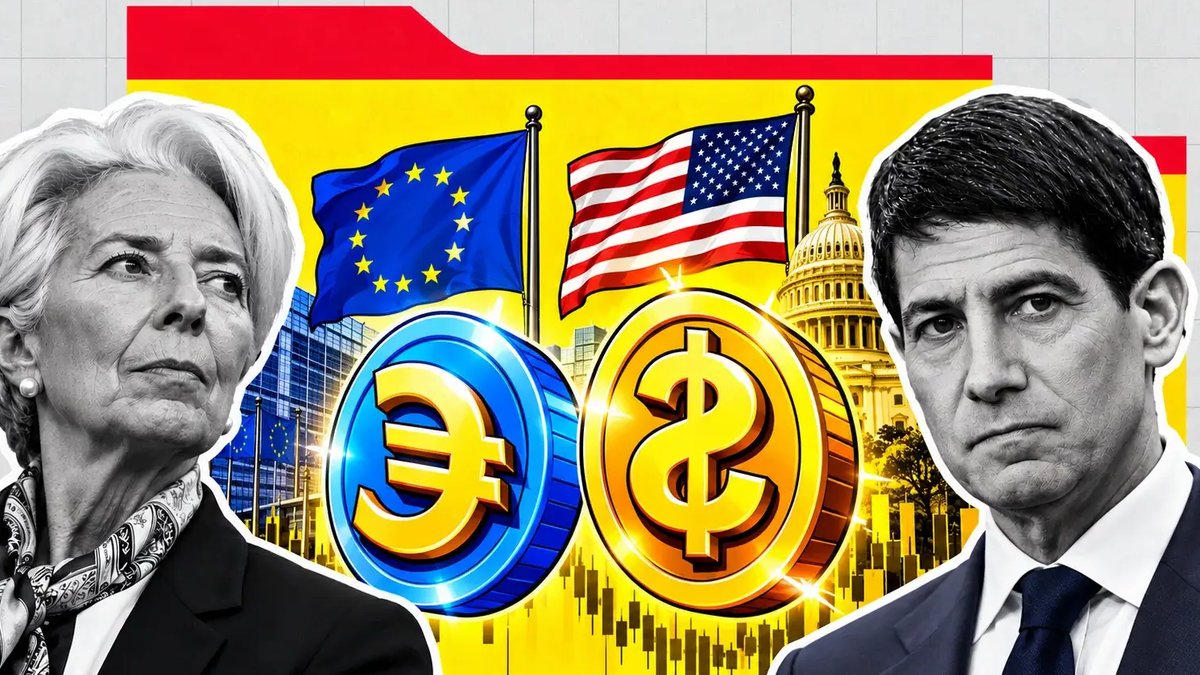
EUR/USD trades at 1.1615, holding the middle of a range that has defined the currency pair for most of the quarter. The pair closed Friday near 1.1629, absorbing a U.S. employment report that should have crushed it and refusing to move significantly. This resilience is the story of the week. The market is not trading direction, but the second derivative of policy. Both the European Central Bank and the Federal Reserve are tightening, and the pair sits in the middle of a battle where the expected moves cancel each other out.
The Employment Report That Didn’t Move the Dollar
U.S. nonfarm payrolls grew by 162,000 in August, sharply exceeding expectations of around 55,000. The unemployment rate held at 4.1%, and June and July payroll figures were revised higher by a combined 55,000. The two-year Treasury yield climbed to 4.37%, its highest since January 2025, and the 10-year finished at 4.784%. Fed funds futures moved the probability of a September hike to around 60% from roughly 50%.
That is a textbook dollar-bullish package, yet EUR/USD went nowhere. The pair held 1.1629 into the release and opened Monday at 1.1615, a decline of 14 pips, or 0.12%, across the single most important U.S. data point of the month. The technical read from Friday’s close was that the pair defended support for a second consecutive week. Two weeks of successful defense at the same zone is a structural signal, not noise.
Read Also: Adobe stock analysts see strong growth potential
The muted dollar response has three parts. First, positioning was already long dollars going into the print. US dollar longs held firm into Jackson Hole while euro, yen, and commodity currencies sat on the other side, meaning the payroll surprise had fewer incremental buyers to attract. Second, the euro carried its own hawkish catalyst 72 hours out, providing a bid that limited downside. Third, the fiscal and policy backdrop in the U.S. has become a live drag on the dollar independent of rate expectations.
Inflation in the Eurozone Is an Oil Problem
The data that justifies Thursday’s hike arrived on September 1, and it was uglier at the headline than underneath. Euro area annual inflation came in at 3.3% in August 2026 on the flash estimate, up from 2.9% in July. That is the highest reading since September 2023 and sits well above the ECB’s 2% target. Energy inflation jumped to 14.3% in August from 10.3% in July, its highest level since January 2023. Given energy’s 9.0% weight in the harmonised index, a four-percentage-point acceleration in that component alone contributes roughly 0.36 points to the headline, which accounts for almost the entire 0.4-point rise.
The rest of the basket moved in the opposite direction or barely at all. Services inflation eased to a four-month low of 3.0% from 3.3%. Non-energy industrial goods rose to 1.2% from 0.9%. Food, alcohol and tobacco held at 1.2%. Country dispersion widened. Inflation accelerated in Germany to 2.9% from 2.8%, France to 2.7% from 2.4%, Spain to 4.5% from 3.9%, and Italy to 3.2% from 2.9%. Spain at 4.5% against Germany at 2.9% is a 160-basis-point spread inside a single currency union, complicating a one-size policy decision.
The source of the energy shock is not domestic. Brent crude trades at $97.27 with WTI at $91.98. Brent touched $97.93, its highest since July 24, and gained 7.6% last week alone. Diesel has hit a record $5.85 per gallon in the U.S., with European distillate markets tracking the same squeeze.
Read Also: Yen Stalls at 159 Despite Hawkish Speech
The Core Problem
Underneath the 3.3% headline is a number that argues against sustained tightening. Core inflation, excluding energy, food, alcohol and tobacco, edged down to 2.4% in August from 2.5% in July, coming in below forecasts of 2.5%. Inflation excluding energy alone held at 2.2%. Excluding energy and unprocessed food, the rate slipped to 2.1%. Three separate core measures, all easing, all within half a point of the 2% target. That is not an inflation problem. That is an oil problem.
Services inflation matters most in this context because services carry a 46.8% weight in the euro area HICP. Services eased to 3.0% in August from 3.3%, a four-month low. Since services inflation is the component most closely tied to domestic wage pressure and the one the ECB has consistently identified as the sticking point, its decline removes the strongest domestic argument for tightening. The tension this creates for Thursday is genuine. The Governing Council is being asked to raise rates because imported energy prices are high, while the components it can actually influence are converging toward target. Monetary policy does not produce oil.
The August core reading of 2.4% is already running below the June staff projections, which put the medium-term core path at 2.5% in 2026. If Thursday’s updated staff forecasts revise the medium-term core path lower while raising the near-term headline, the central bank will have to explain why a hike is warranted for a shock the bank expects to fade. The explanation is what EUR/USD trades on Thursday afternoon. A hike delivered with dovish framing sells the euro despite the tightening. A hike with the door left open sends it at 1.1700.
Read Also: Gold Surges To $4526 After Waller Comments
ECB and Fed: 65 Economists Agree, But Guidance Matters
The decision itself carries almost no informational content. The press conference carries all of it. The outlet found 65 economists favoring a 25-basis-point increase in the deposit rate to 2.50%, and markets are fully pricing that move.
Current expectations for U.S. inflation are being reshaped by the payroll report. The probability of a 25-basis-point hike at the September 15-16 meeting is now near 58% to 60%, up from roughly 50% before the release. The committee is genuinely split. Governor Christopher Waller said he would be inclined to support keeping rates unchanged if price pressures continue easing. The Fed is now in its pre-meeting blackout, meaning Friday’s CPI does all the work.
With 60% priced for a hike, a hot CPI confirms what is already in the price and delivers limited incremental dollar strength. A cool core reading has to unwind a 60% probability from a starting point where positioning is already long dollars. That asymmetry is the strongest argument for EUR/USD upside this week, and it has nothing to do with the euro. Concerns about rising U.S. government debt and economic policy uncertainty are adding pressure independent of rate expectations, which is why the payroll beat produced a rally that faded rather than a breakout.


Leave a Reply