
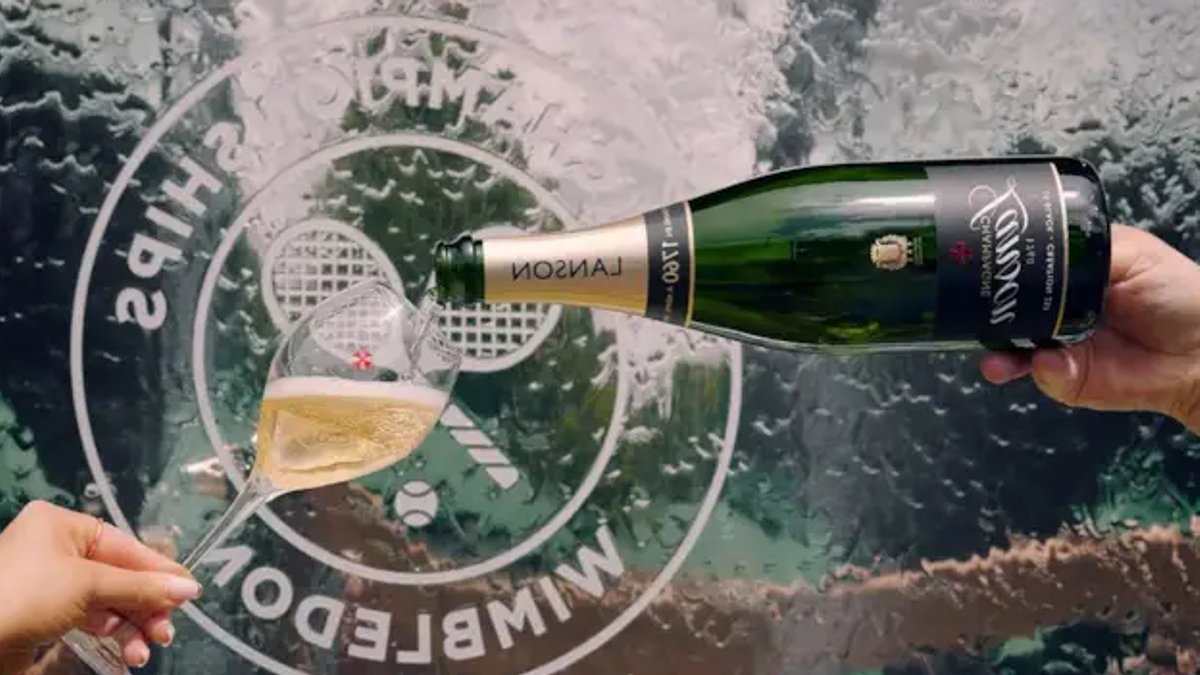
Tennis and champagne share a bond that goes beyond simple marketing. The connection traces back to historic estates and old money, rooted in the sport’s origins. Wimbledon stands out as the most exclusive event on the calendar. The All England Lawn Tennis & Croquet Club serves as the venue for this high-stakes pairing, requiring players to respect the delicate balance of tradition and competition. According to the tournament’s records, roughly 24,500 bottles are opened during the two weeks of play. An official announcement from the club warns spectators not to pop corks while players prepare to serve, a rule enforced strictly to maintain order on the grass.
Wimbledon’s Long-Standing Partnership
Lanson has held the title of official champagne provider for decades. The brand is a historic partner of the tournament, a relationship that will celebrate its 50th anniversary in 2027. The connection is subtle, fitting the “total white” dress code that governs the event. Lanson produces special editions for the event, such as Le Black Création and Le Rosé Création, which are sold in airport terminals and on-site shops. These products allow fans to take a piece of the Wimbledon experience home. The focus remains on the sport, with champagne flowing in the background of the matches rather than stealing the spotlight from the athletes.
Related: Equita raises Icop target as Norges holds stake
While the connection between champagne and tennis is strong, the specific brands used can vary significantly across different events. The Australian Open, for instance, partners with Piper-Heidsieck. The brand operates a red tent near the Rod Laver Arena and a kiosk called Le Kiosque in Garden Square. The “On-Court presented by Piper-Heidsieck” package offers a luxury experience, including court-side seating and access to the Sushi Room, an omakase restaurant located beneath the arena. This contrasts with the American Open, where Moët & Chandon holds the title of official champagne. Moët & Chandon is a dominant force in the industry, part of the Moët Hennessy conglomerate that also owns Dom Pérignon, Krug, Ruinart, and Veuve Clicquot.
Global Reach of the Bubbles
The partnership between champagne houses and tennis tournaments often follows a global pattern.
Related: Finde overtakes Diasorin with strong bond issue
Not every tournament relies on French champagne. The Italian Open in Rome has turned to domestic sparkling wine for its official beverage. Following the Italian Open final, Jannik Sinner celebrated with magnums of a local drink. The Austrian Open in Vienna features Schlumberger Sekt, the local Austrian sparkling wine that received Protected Designation of Origin status in 2022. The quality of these regional options continues to rise, offering a valid alternative to the prestigious French brands found on the international stage.
Regional Options and Market Shifts
The global setting of sports sponsorships often shifts to include local producers. The Italian Open’s decision to feature a domestic brand demonstrates how local brands can compete with established French houses. The Austrian Open in Vienna features Schlumberger Sekt, the local Austrian sparkling wine that received Protected Designation of Origin status in 2022. This trend suggests that the market is moving beyond a reliance on traditional French labels.


Leave a Reply